If you were asked to build a bridge across a small creek and you wanted it to be as strong as possible, your intuition might tell you to use a solid log or a thick, solid metal bar. Our brains are wired to equate “solid” with “strong” and “heavy” with “durable.”
But if you look at the bones of a bird, the frame of a Formula 1 car, or the boom of a construction crane, you notice something contradictory: they are hollow.
In the world of structural engineering, mass is often the enemy. Every pound of material you add to a structure is a pound that the structure has to support before it even carries a payload. The secret to modern construction isn’t just finding stronger materials; it is finding better shapes. And it turns out, the most efficient shape is often one that is mostly made of air.
The Lazy Center
To understand why a hollow tube is often superior to a solid bar, you have to look at what happens when a beam bends.
Imagine you are bending a stick over your knee. The wood fibers on the top of the stick are being stretched (tension). The fibers on the bottom are being squashed (compression).
But what about the fibers in the very center of the stick?
Mathematically, the fibers in the exact middle are doing almost nothing. They are under zero tension and zero compression. This is called the “Neutral Axis.”
In a solid bar, the material in the center is essentially dead weight. It adds mass to the object, but it contributes very little to resisting the bend. It is a passenger, not a worker.
The “Moment” of Truth
Engineers solve this by moving the material away from the center. By taking that “lazy” material from the middle and pushing it out to the edges, you increase the “Area Moment of Inertia.”
This is the physics behind the I-beam, and it is the physics behind tubing.
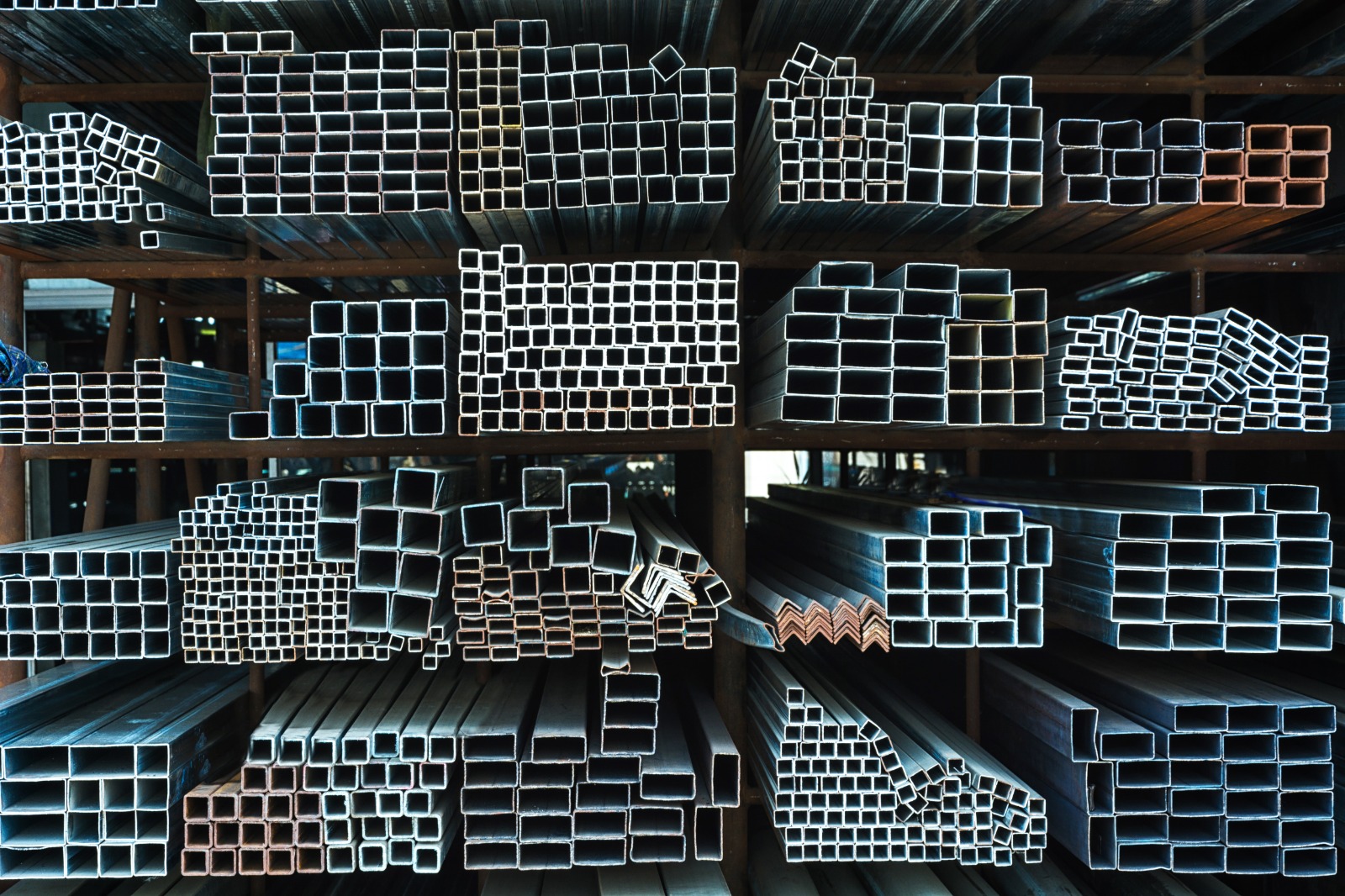
If you take 10 pounds of aluminum and forge it into a solid rod, it will be relatively thin. If you take that same 10 pounds of aluminum and extrude it into a large, hollow square tube, the walls will be thin, but the overall diameter will be much larger.
Because the metal is now located further away from the neutral axis, it has more leverage to stop the bend. The hollow tube will be significantly stiffer and harder to buckle than the solid rod, despite weighing exactly the same. You have used geometry to “hack” the strength of the material.
Square vs. Round: The Fabrication Factor
So, we know hollow is better than solid for efficiency. But why square instead of round?
Round tubing (pipe) is fantastic for handling internal pressure (like water or gas) and for resisting twisting forces (torsion). A driveshaft in a car is round for a reason.
But for building frames—tables, racks, trailers, gazebos—square and rectangular tubing offers a distinct advantage: flat sides.
Joining two round pipes is difficult. You have to “fish-mouth” or notch the end of one pipe to fit the curve of the other. It requires complex cutting and skilled welding.
Joining two square tubes is simple. You cut them at 45 degrees or 90 degrees, and the flat surfaces mate perfectly. They are easy to bolt, easy to weld, and easy to mount things to. You don’t need a special bracket to attach a flat piece of plywood to a flat square tube; you just screw it on.
The Material Match
When you combine this efficient geometry (hollow) with a high-performance material like aluminum, you get a “super-material.”
Steel is strong, but it is heavy. A steel tube frame might be overkill for a solar panel array or a trade show booth. Aluminum is one-third the weight of steel. By using an aluminum alloy (like 6061-T6) in a hollow square profile, you create a structure that is rigid enough to hold thousands of pounds but light enough for two people to pick up and move.
Conclusion
The next time you look at a skyscraper, a bicycle frame, or an aircraft fuselage, look for the empty space. The strength of the structure doesn’t come from the sheer volume of metal; it comes from the intelligent placement of that metal.
Engineering is the art of doing more with less. By recognizing that the center of the beam is a free-loader, we can hollow it out, saving money and weight without sacrificing safety. Whether you are a hobbyist building a roof rack or an architect designing a canopy, the success of your project often depends on finding a reliable aluminum square and rectangular tubing supplier who can provide the precise geometric profiles that allow you to build lighter, smarter, and stronger. The strongest component in your design might just be the air inside the tube.